
Written by Irene Liang, Director of Sales at Hayne Industry
This article is based on customer discussions and new ring die start-up cases handled by the Hayne team. Customer names and commercially sensitive details have been omitted.
One of the most frustrating messages we receive usually begins with the same question:
“The old ring die was still running normally. Why did the motor current increase as soon as we installed the new one?”
Sometimes pellet discharge becomes slower. Sometimes only part of the ring die starts producing. In more serious cases, material builds up in front of the rollers and the die blocks shortly after start-up.
Naturally, the first suspicion falls on the new ring die.
And sometimes that suspicion is correct.
The die holes may not be smooth enough. The effective compression length may not suit the actual raw material. There may also be a machining or design problem that needs to be checked.
But over the years, we have also seen workable ring dies run into trouble because of the conditions around them.
The run-in was not fully completed. The operator used the same feeding rate as before. The existing roller shells were heavily worn. The die-roller clearance was not reset. Or the raw material was described as “the same,” even though its moisture, particle size or composition had changed.
From the control room, these problems can look almost identical.
The motor current rises. Capacity does not follow. Pellet discharge becomes unstable.
Based on the cases we have handled, higher motor current after installing a new ring die usually comes from one or more of several areas: incomplete run-in, feeding increased too quickly, compression that does not suit the actual material, changed raw material conditions, or a problem with the roller condition and die-roller clearance.
The first step is therefore not to blame or defend the ring die.
Reduce the feeding rate, compare motor current with actual pellet discharge, and look at whether pellets are coming out across the full working width.
If the resistance remains unusually high after discharge has stabilized, then the ring die design and manufacturing condition should be reviewed.
The motor current tells us that the pellet mill is working harder.
It does not tell us why.
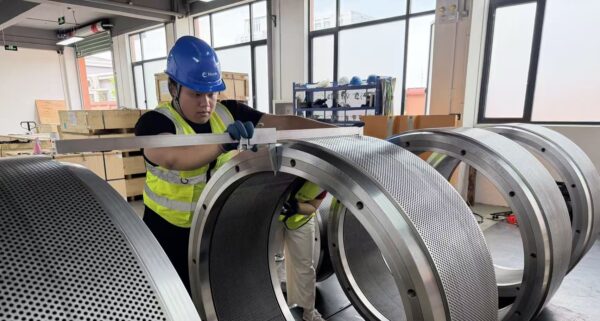
A new ring die before installation. Its start-up performance depends on the ring die itself, but also on feeding, raw material, run-in and roller condition.
Start with What the Pellet Mill Is Actually Doing
Motor current is useful, but it should never be read alone.
It needs to be compared with pellet output and the actual discharge condition.
If the feeding rate increases, the current rises moderately and pellet output rises with it, the pellet mill may simply be responding to a higher production load.
The more concerning situation is when the feeding rate increases and the current rises quickly, but pellet output hardly changes.
That usually means more material is entering the pelleting chamber, while not enough material is passing through the ring die.
Continuing to increase the feed rarely helps.
Material is already accumulating in front of the rollers, and more material is being added on top of it. The load continues to increase until the pellet mill trips or the ring die blocks.
At this point, the first action is usually simple:
Reduce the feeding rate and watch the discharge.
Look at the entire working width of the ring die.
Are pellets coming out evenly?
Are most of the die holes producing?
Is one section discharging normally while another section is almost inactive?
Does the motor current begin to fall when the feeding rate is reduced?
These observations often tell us much more than one current reading or one capacity figure.
The Old Ring Die May No Longer Be a Fair Comparison
When a production team compares a new ring die with the old one, it is easy to assume that the only difference is age.
In reality, the old ring die may have changed considerably during operation.
After producing a large quantity of pellets, material passing through the die holes continuously polishes the internal surfaces.
The hole inlets may become worn. The shape of the compression channel may also change gradually.
As a result, the old ring die may become easier to run than it was when first installed.
Operators also adapt to it.
Over time, feeding rate, moisture, conditioning and other production settings may all have been adjusted around the worn ring die, even if nobody made a formal decision to do so.
Then the old die is replaced.
The new ring die restores the original hole geometry and compression condition. Suddenly, the feeding rate that worked yesterday creates much more load today.
This does not prove that the new ring die is correct.
But it does mean that comparing the two ring dies only by motor current can be misleading.
Sometimes the old ring die was running easily because it was already worn.
Did the New Ring Die Ever Get a Proper Start?
Even when a new ring die is correctly manufactured and its compression design is suitable, we do not recommend installing it and moving directly into full-load production.
A new ring die should first go through a proper run-in procedure.
Some pellet plants call this “washing the die.”
This does not mean washing the ring die with water. It means passing suitable, plant-approved run-in material through the die holes before applying the normal production load.
The exact material and procedure should follow the pellet mill manufacturer’s instructions and the plant’s own product and hygiene requirements.
The purpose of run-in is not simply to operate the ring die for a certain number of minutes.
It is to establish stable discharge and give the operator a chance to see how the new ring die is actually behaving.
During the process, we normally watch whether:
- more die holes begin producing;
- discharge becomes more even;
- motor current starts to stabilize;
- material continues to accumulate in front of the rollers;
- the ring die becomes easier to run as feeding is increased.
If only a limited area of the ring die is producing, the start-up is not yet stable, even if some pellets are already coming out.
Hayne can also carry out a pre-shipment run-in when requested. This allows us to check the initial discharge condition before the ring die reaches the customer’s plant.
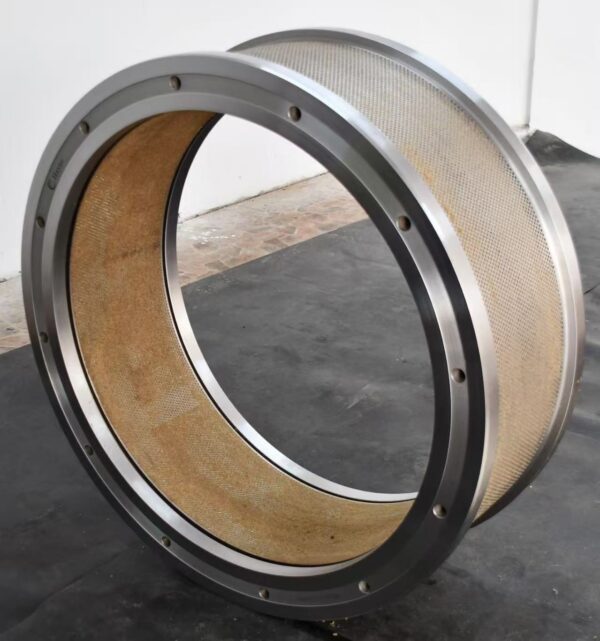
After a proper run-in, pellet discharge should become more even before the pellet mill is taken toward its normal production load.
We recently dealt with a case like this.
The customer installed a new ring die and immediately noticed that the motor current was higher than before.
Their first concern was that the effective compression length might be too high.
That was also one of the possibilities we considered, but we did not want to change the ring die design before checking how it had been started.
After discussing the operating details, we found that the pellet mill had started producing, but the run-in had not really been completed. Discharge across the ring die was still not fully stable.
The customer ran the ring die in again and increased the feeding rate more slowly.
As more holes began to discharge normally, the current gradually came down. The pellet mill eventually returned to stable production without changing the effective compression length.
This does not mean that every high-current problem can be solved by run-in.
It means that current alone is not enough to judge the ring die.
There is also a limit to the run-in explanation.
If the motor current remains unusually high after the ring die has been properly run in, the material condition is stable and the feeding rate is controlled, we would not continue telling the operator to “just run it longer.”
At that point, something else needs to be checked.
Going to Full Load Too Quickly Can Block the Ring Die
Another customer experienced a more serious problem.
The new ring die blocked soon after installation.
At first, it looked like a straightforward ring die problem. But when we went through the start-up process with the operator, we found that the pellet mill had gone almost directly to its previous production load.
The feeding rate was based on the old ring die.
The new ring die had not yet established stable discharge.
Material was entering the pelleting chamber faster than it could leave through the die holes. The current increased, material accumulated in front of the rollers, and discharge became progressively worse.
Eventually, the ring die blocked.
After the die was cleared, the customer completed the run-in procedure and restarted at a lower feeding rate.
The load was then increased step by step as discharge became stable.
The blocking did not repeat.
A new ring die does not need to prove its maximum capacity in the first few minutes.
First make sure the material can pass through it properly.
Then increase the load.
Full-load production should be the result of a successful start-up, not the starting point.
Sometimes the Compression Design Really Is Too High
Run-in is important, but it should not become an explanation for every new ring die problem.
Sometimes the resistance really does come from the ring die design.
Customers often describe what they need by pellet diameter:
“We need a 6 mm ring die.”
But 6 mm only tells us the pellet diameter.
It does not tell us how difficult the material will be to press.
Two ring dies with the same hole diameter can behave very differently if they have different effective compression lengths, inlet designs, relief structures or hole arrangements.
The raw material changes the result again.
Softwood, hardwood, mixed wood and agricultural biomass do not behave in the same way under pressure.
In feed production, a high-fiber formula can behave very differently from a formula containing more fat, starch or better-conditioned ingredients.
If the effective compression is too high for the actual material, the symptoms may include:
- unusually high motor current;
- slow pellet discharge;
- lower-than-expected capacity;
- rising ring die temperature;
- difficult start-up;
- repeated blocking.
Reducing the feeding rate may allow the pellet mill to continue running, but it does not necessarily solve the underlying problem.
The machine may remain below the expected capacity, or the problem may return as soon as the operator tries to increase production.
In that situation, we need to review more than the hole diameter.
We look at the effective compression length, inlet geometry, relief design, raw material, moisture, conditioning and expected pellet quality.
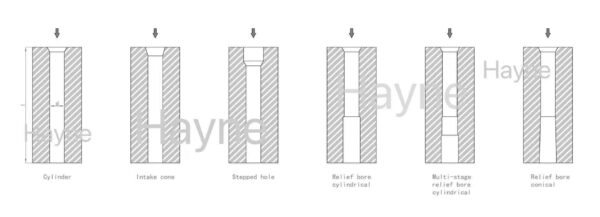
Pellet diameter is only one part of ring die design. Effective compression length, inlet geometry and relief all influence pelleting resistance.
This is why we are cautious when someone says:
“It is a new ring die. Just run it longer.”
Sometimes more run-in is exactly what the ring die needs.
Sometimes the resistance is genuinely too high for the material.
Those two situations may look similar at the beginning, but they require different solutions.
The Internal Surface of the Die Holes Also Matters
A ring die hole is not simply a hole drilled through steel.
During production, raw material is pushed through thousands of small compression channels under high pressure.
The material remains in contact with the internal wall of each hole as it moves through the ring die.
If the internal surface is too rough, friction can increase.
The first signs are usually practical rather than dramatic.
Pellets may come out more slowly. The motor current may rise. Material may begin to accumulate in front of the rollers. Some holes may discharge normally while others remain partly blocked.
In more serious cases, the ring die becomes increasingly difficult to run.
At Hayne, we check the internal surface roughness of the die holes on every ring die, rather than only inspecting occasional samples.
Our internal requirement is:
Die-hole surface roughness: Ra ≤ 0.5 μm
We pay attention to this because the material has to travel along that surface under pressure.
A smoother and more consistent internal surface helps reduce unnecessary friction and gives the new ring die a better starting condition.
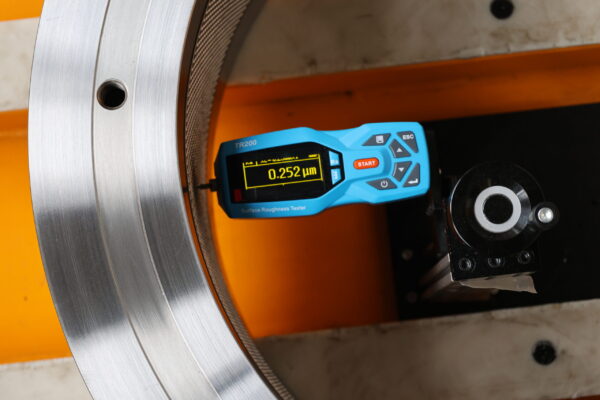
The internal surface roughness is checked on every Hayne ring die, with an internal requirement of Ra ≤ 0.5 μm.
Of course, a smooth hole does not guarantee that the ring die will run well under every condition.
If the effective compression is unsuitable, the raw material is difficult to press or the roller setup is incorrect, the pellet mill may still experience high resistance.
But if a ring die remains difficult to discharge after a proper start-up, the internal hole condition should be part of the investigation.
“The Raw Material Is the Same” Does Not Always Mean the Condition Is the Same
When a customer tells us that the raw material is exactly the same, we usually ask a few more questions.
For biomass production:
- Is the measured moisture really the same?
- Is the particle size distribution unchanged?
- Is the proportion of softwood, hardwood or bark the same?
- Has agricultural or recycled material been added?
- Has storage time or weather affected the material?
For feed production:
- Is the formula unchanged?
- Has the fiber or fat level changed?
- Is the steam condition stable?
- Is the conditioning temperature the same?
- Has the grinding fineness changed?
- Is the conditioner retention time consistent?
In production, the material may have the same name while behaving differently inside the pellet mill.
Material that is too dry can increase resistance considerably in biomass pelleting.
In feed production, moisture is only one part of the picture. Fiber, fat, starch, particle size, steam quality and conditioning all affect how the material moves through the ring die.
An old, worn ring die may tolerate some of these changes.
A new ring die can expose them immediately.
So instead of asking only:
“Is it the same material?”
we prefer to ask:
“Is the material in the same measurable condition as before?”
The difference matters.
Do Not Forget the Roller Shells
A ring die does not work by itself.
The roller shells form the other half of the pressing system.
One of the most common arrangements in pellet plants is:
New ring die with used roller shells
There is nothing automatically wrong with this combination.
But the condition of the roller assemblies has to be considered.
The previous ring die and the existing rollers may have worn together over a long period. Once the ring die is replaced, their working relationship changes.
If the roller shells are heavily worn, if a roller does not rotate freely, or if the die-roller clearance is not reset correctly, the pellet mill may develop:
- uneven pressure;
- poor material distribution;
- unstable discharge;
- high local load;
- blocking in one area of the ring die.
When discharge is uneven, we do not only inspect the ring die.
We also check the roller shell surface, bearing condition, radial and axial play, roller alignment and die-roller clearance.
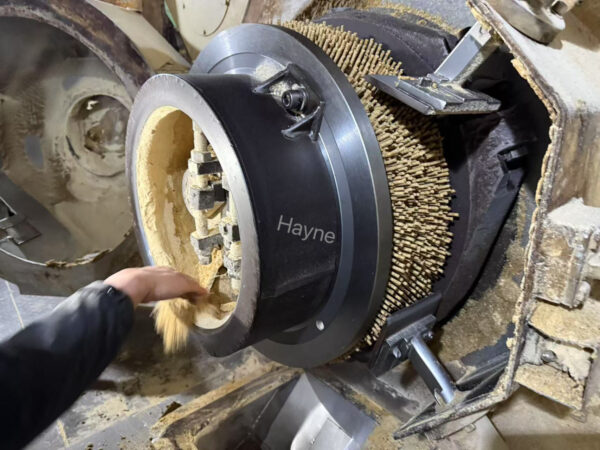
When discharge is uneven, roller wear, bearing condition, alignment and die-roller clearance should be checked together with the ring die.
The discharge pattern can provide a useful clue.
If the entire working width is difficult to run, the cause may be related to overall compression, die-hole condition or raw material.
If one section produces normally while another section struggles, the problem may be more localized.
Possible causes include incorrect roller adjustment, uneven material distribution, roller bearing problems or blocked holes in one area.
There is no single die-roller clearance value that should be applied to every pellet mill.
The correct setting depends on the machine design, operating condition and manufacturer’s instructions.
The roller shell surface pattern can also affect material grip and distribution. We have explained the main options in our article on different pellet mill roller shell types and how to choose them.
Avoid Changing Everything at the Same Time
When a new ring die starts blocking, the natural reaction is to make several changes quickly.
Reduce the feeding rate. Add moisture. Adjust the rollers. Change the formula. Run the ring die again.
The pellet mill may eventually start producing, but nobody will know which change actually solved the problem.
That makes the next incident much harder to diagnose.
We prefer to work through the problem in a simple order.
First, stop increasing the feeding rate.
If the current is already high, allow the ring die to discharge the material already inside the pelleting chamber.
Then look closely at the pellet discharge.
Do not only look at total capacity. Check whether pellets are coming out across the entire working width.
After that, confirm how the new ring die was run in.
If the run-in was skipped or stopped too early, complete it before pushing for normal production capacity.
The next step is to compare the current with the output.
Does the current come down when the feeding rate is reduced?
Does pellet flow become more even?
Can the feeding rate be increased gradually without the current rising disproportionately?
Then compare the actual raw material and conditioning data with the previous production conditions.
Finally, inspect the roller system.
If the problem remains after these checks, we return to the ring die itself and review:
- internal die-hole surface condition;
- effective compression length;
- inlet and relief design;
- hole arrangement;
- machining quality;
- compatibility with the actual raw material.
This approach may require a little more patience at the beginning, but it gives us a much better chance of finding the real cause.
When Is It No Longer a Normal Start-Up Problem?
A new ring die start-up is usually moving in the right direction when more holes begin producing, the discharge becomes more even and the motor current gradually stabilizes.
The feeding rate should be able to increase step by step without the current rising out of proportion to the output.
Further investigation is needed when the opposite continues to happen.
For example:
- the motor current remains extremely high even at a controlled feeding rate;
- the ring die blocks repeatedly;
- discharge remains seriously uneven;
- very few holes are producing;
- ring die temperature continues to increase abnormally;
- there is little improvement after proper run-in;
- the same pellet mill and material run normally with another suitable ring die.
A correctly designed and manufactured new ring die should show clear improvement after a proper start-up.
The operator should not be told indefinitely to keep running it and hope the problem disappears.
Sometimes the cause is run-in.
Sometimes it is feeding.
Sometimes it is the material or roller setup.
And sometimes it really is the ring die.
What Information Helps Us Diagnose the Problem?
When a customer only tells us, “The current is high,” there is usually not enough information to make a reliable judgment.
The following details are much more useful:
- pellet mill brand and model;
- ring die drawing or main dimensions;
- hole diameter and effective compression length;
- raw material or feed formula;
- measured moisture;
- particle size;
- conditioning temperature and steam condition;
- motor current before and after replacing the ring die;
- output before and after replacement;
- roller shell condition and operating time;
- die-roller clearance;
- photos or videos showing pellet discharge across the full working width.
A short video is often especially helpful.
It can show the motor current, feeding condition and actual pellet discharge pattern at the same time.
That usually tells us more than several messages saying that the ring die is “difficult to run.”
For other related problems, you can also read our guides to common pellet mill ring die problems and their causes and how to inspect and maintain ring dies.
Final Thoughts
A new ring die with higher motor current should not be blamed immediately.
But the problem should not be dismissed as normal run-in without evidence either.
The resistance may come from incomplete run-in, excessive feeding, unsuitable compression design, rough die-hole surfaces, changed raw material conditions, worn rollers or incorrect machine adjustment.
It may also come from a genuine ring die manufacturing problem.
The most reliable way to find out is to follow what the pellet mill is telling us and eliminate the possible causes one by one.
Watch the motor current together with pellet output.
Look at the full discharge pattern.
Do not go directly to full load.
And do not keep using “run it longer” as the answer when the machine is showing no real improvement.
In the end, high current is only a symptom.
The real work is finding where the resistance comes from.
About the Author
Irene Liang is Director of Sales at Hayne Industry.
She works directly with pellet producers, distributors, and Hayne’s production and technical teams on ring die selection, product specifications, new ring die start-up problems, performance feedback and after-sales troubleshooting.
The observations in this article are based on real customer discussions and cases handled by the Hayne team. Customer identities and commercially sensitive details have been omitted.